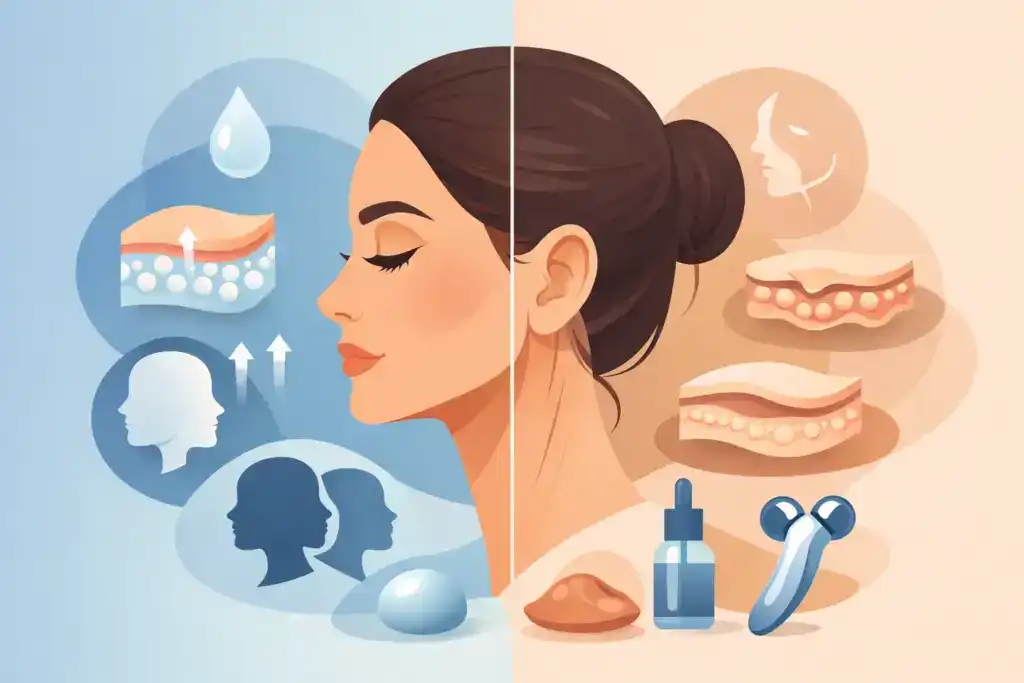
A face rarely changes all at once. More often, it is a gradual shift – the cheeks look a little flatter, the under-eye area seems more hollow, the jawline less supported, and the skin no longer reflects light the same way. When patients ask what causes facial volume loss, they are usually noticing this quiet change in facial structure rather than a single wrinkle or line.
Facial volume loss is not just about getting older, and it is not simply about fat disappearing. It reflects changes in multiple layers of the face, including bone, fat, skin, muscle, and connective tissue. That is why a refined treatment plan starts with understanding what has changed, where it has changed, and whether restoration is actually the right approach.
What causes facial volume loss as we age?
The short answer is time, but the more accurate answer is structural change. The face ages in layers, and those layers do not all change at the same speed.
One of the most significant factors is the gradual loss and redistribution of facial fat. In youth, fat compartments in the face are fuller and more evenly supported, which creates soft contours in the cheeks, temples, and around the mouth. Over time, some of those fat pads shrink, while others descend. The result is not simply a thinner face. It is often a face that appears less lifted, less rested, and less balanced.
At the same time, the skin itself becomes less resilient. Collagen, elastin, and hyaluronic acid decline with age, which affects firmness, hydration, and elasticity. Even if facial volume has only changed modestly, thinner and less elastic skin can make hollowing appear more obvious.
Another piece that is often overlooked is bone resorption. The facial skeleton changes with age, especially around the eyes, midface, and jaw. As underlying bone support decreases, the soft tissues above it have less structure to rest on. This can contribute to a sunken under-eye area, flattening of the cheeks, and reduced definition through the lower face.
These changes are normal, but they do not happen identically in every patient. Genetics, lifestyle, skin quality, and overall health all shape how volume loss appears.
The main reasons facial volume loss happens
Aging is the most common driver, but it is not the only one. In practice, facial volume loss is usually influenced by a combination of factors.
Natural aging and genetics
Some patients are genetically predisposed to lose facial fullness earlier or more noticeably than others. A naturally lean face can look elegant in youth, but it may show hollowing sooner in the temples, cheeks, or under-eye area. Others retain volume longer but develop heaviness or descent instead. This is why treatment should never be based on age alone.
Weight loss
Weight loss can improve health and body composition, but it often affects the face as well. This is particularly true after rapid or significant weight reduction. The cheeks may appear deflated, the lower face can look less supported, and lines around the nose and mouth may seem deeper.
Not every patient wants to reverse that change completely. In many cases, the goal is not to look fuller everywhere, but to restore enough structure to maintain harmony. That distinction matters. Overcorrection can look artificial, especially in a patient whose features are naturally refined.
Hormonal changes
Hormones influence skin thickness, hydration, collagen production, and fat distribution. During perimenopause and menopause, many women notice that the face begins to look less firm or less lifted, even if body weight has stayed relatively stable. This is not imagined. Hormonal shifts can accelerate visible aging and make volume loss more apparent.
Sun exposure and environmental stress
Ultraviolet damage does not remove facial fat directly, but it degrades collagen and elastin, weakens skin quality, and contributes to a thinner, more creased appearance. Over time, this can exaggerate shadowing and make structural changes look more advanced than they actually are.
Smoking, chronic stress, poor sleep, and inadequate nutrition can create a similar effect. The face often reflects cumulative strain.
Illness, medication, or intense exercise
Certain medical conditions, medications, and periods of prolonged physical stress can affect body fat and facial fullness. Patients who are very active and maintain low body fat percentages sometimes notice earlier volume loss in the face, particularly in the midface and temples. That does not mean exercise is a problem. It means facial aging is influenced by overall physiology, not just skincare.
Where facial volume loss shows up first
Volume loss tends to be most visible in areas that shape facial light and contour. The temples may become hollow, which can make the upper face look more skeletal. The cheeks often flatten, reducing the soft curve that gives the face a rested appearance. Under the eyes, loss of support can create a tired or shadowed look.
In the lower face, volume loss can make nasolabial folds and marionette lines appear deeper, even though those lines are not always the primary issue. Often, the problem begins higher in the face, where support has diminished. The lips may also lose definition and hydration over time, and the jawline can appear less crisp as surrounding tissues shift.
This is one reason experienced assessment matters. A line is not always a line problem. A hollow is not always a volume problem. Sometimes skin tightening, resurfacing, biostimulation, or a broader wellness strategy makes more sense than simply adding filler.
Why volume loss can make you look tired or older
The face is read in three dimensions. When volume is lost, shadows deepen, contours flatten, and the transitions between facial features become more abrupt. Even if the skin is healthy, a reduction in structural support can create a tired, stern, or drawn appearance.
Patients often describe this as looking older without being able to identify exactly why. They may say they still resemble themselves, but less refreshed. That is a useful instinct. The goal in aesthetic medicine should not be to chase youth aggressively. It should be to understand which changes are creating visual imbalance and whether subtle correction can restore a more rested version of the same face.
Can facial volume loss be prevented?
Prevention has limits, because some degree of facial aging is inevitable. Still, the pace and visibility of volume loss can often be influenced.
Daily sun protection helps preserve collagen and skin quality. Consistent skincare can support the barrier and improve texture. Stable weight management is often kinder to the face than repeated cycles of gain and loss. Good sleep, adequate protein intake, and attention to hormonal and metabolic health also play a role.
There is no single product or treatment that stops facial aging. What helps most is a long-term, evidence-based approach that considers skin, structure, movement, and overall health together.
How facial volume loss is treated thoughtfully
The best treatment depends on what is actually causing the change. In some patients, carefully placed dermal filler can restore support in the cheeks, temples, jawline, or lower face. In others, collagen-stimulating treatments, skin rejuvenation, or neuromodulators may be more appropriate. Often, a combination produces the most natural result.
Technique matters as much as product choice. Replacing volume is not the same as adding volume. A physician-led plan should account for facial proportions, tissue quality, and the way each area influences the rest of the face. More is not better. Better is better.
This is especially true for patients who are concerned about looking overfilled. When treatment is guided by anatomy and restraint, the aim is subtle support, not obvious alteration. At Leo & Lucy Medical Aesthetics, that philosophy is central to how facial aging is assessed and treated.
A consultation is also the right time to discuss whether volume restoration should happen now, gradually, or not at all. Sometimes the most elegant plan is staged over time. Sometimes a patient benefits more from improving skin quality first. And sometimes reassurance is the treatment – because what appears dramatic in the mirror is actually mild and very manageable.
If your face looks less rested, less lifted, or less like itself, volume loss may be part of the picture, but it is rarely the whole story. Understanding the cause is what allows treatment to be precise, safe, and natural-looking. The right plan should not change your identity. It should restore balance with enough subtlety that you simply look well.