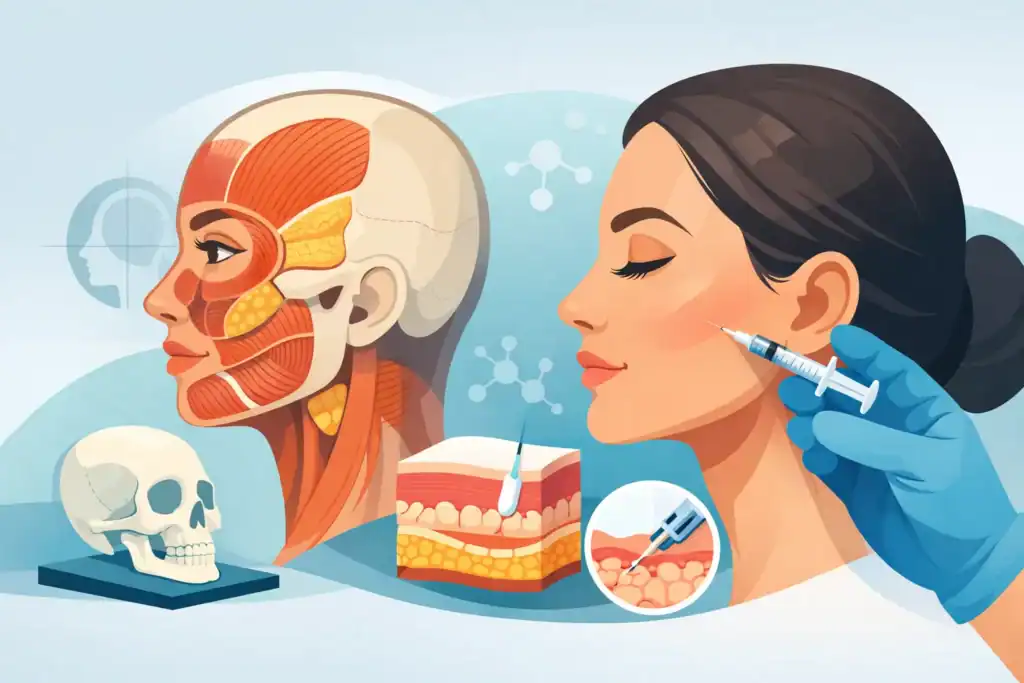
A few millimeters can separate a refined result from one that looks heavy, uneven, or simply not like you. That is why how facial anatomy improves injections is not a minor technical detail. It is the foundation of safe, elegant aesthetic medicine.
Injectables are often discussed as products, units, or syringes. In practice, the more important question is where, why, and in whom a treatment is placed. Every face has its own structure, movement patterns, vascular pathways, fat compartments, and age-related changes. When an injector understands those layers deeply, treatment becomes more precise, more personalized, and far more likely to look natural.
Why facial anatomy matters before any injection
The face is not flat, and it does not age evenly. Bone support changes over time. Fat pads descend or deflate. Muscle activity strengthens some lines while softening others. Skin quality, hydration, and ligament support all influence how the face presents at rest and in motion.
This is where anatomy shifts the entire approach. Instead of treating a wrinkle in isolation, an experienced injector assesses the structures creating it. A fold near the mouth may reflect volume loss in the cheeks rather than a problem that should be filled directly. Crow’s feet may soften beautifully with neuromodulator treatment, while under-eye creasing may worsen if the surrounding anatomy is not respected. The visible concern is only part of the story.
A physician-led, anatomy-based assessment helps answer the real clinical questions. Is the issue caused by muscle movement, volume loss, skin laxity, or a combination of all three? Is filler the right answer, or would a different treatment better preserve balance? Those distinctions matter because subtle enhancement depends on treating causes, not chasing symptoms.
How facial anatomy improves injections in real clinical terms
When patients hear that anatomy matters, they often think of safety first, and rightly so. The face contains important blood vessels, nerves, muscles, and structural landmarks. Knowledge of their course, depth, and variation helps guide safer injection technique and reduce avoidable risk.
But anatomy also improves artistry. Better placement means the product can support natural contours instead of creating puffiness or distortion. In the upper face, understanding muscle interplay helps soften expression lines while preserving movement. In the midface, restoring support at the cheek can indirectly improve the under-eye and lower face. In the jawline and chin, treatment can strengthen profile balance without making features look harsh or overbuilt.
The best results are often the least obvious. Someone may look rested, more defined, or simply healthier without anyone identifying a specific treatment. That level of refinement usually comes from an injector who sees the face as an integrated structure rather than a set of disconnected concerns.
Anatomy guides product choice and placement
Not all injectable products behave the same way, and not every area of the face needs the same type of support. Anatomy helps determine both the product and the plane of injection.
A firmer filler may be appropriate where structure and lift are needed, such as the chin or parts of the cheek. A softer filler may suit areas where flexibility and subtle blending are more important. Neuromodulators also require anatomical precision. The exact placement, depth, and dose affect not only line reduction but brow position, symmetry, and facial expression.
This is one reason overgeneralized treatment plans can fall short. Two patients may both request treatment for smile lines, but one may need midface support and the other may benefit more from skin-focused care or conservative lower-face balancing. The visible concern may match. The anatomy does not.
Natural-looking results depend on structural balance
Patients seeking aesthetic treatment today are often very clear about one thing: they want to look like themselves, only more refreshed. Anatomy-based injecting supports that goal because it respects proportion.
A naturally attractive face tends to have harmony between features, not exaggerated fullness in one isolated area. If lips are treated without considering chin projection, dental support, or the rest of the lower face, they can quickly look disconnected. If cheeks are overfilled without attention to facial width and existing bone structure, the result may feel artificial even when the product itself is technically well placed.
An injector with a deep understanding of facial anatomy evaluates the whole face first. They consider profile, asymmetry, tissue thickness, muscle pull, and how light falls across facial contours. Then treatment is built to support overall balance. Sometimes that means doing less than a patient expected. Sometimes it means treating a different area than the one initially requested.
That restraint is not hesitation. It is clinical judgment.
Safety is inseparable from anatomy
Any discussion of how facial anatomy improves injections should include safety without reducing the conversation to fear. Injectable treatments are widely performed and can be excellent options in the right hands, but they are still medical procedures. The face has high-risk zones, and complications are best prevented through education, experience, and careful technique.
Anatomical knowledge helps an injector recognize safer entry points, appropriate depth, and the importance of slow, controlled placement. It also supports better patient selection. Some areas are simply not ideal for every person. Thin tissue, prior filler, scar history, vascular variation, or certain aesthetic goals may warrant a more conservative approach or a different treatment strategy.
This is one of the clearest differences between a transaction-based injection appointment and a comprehensive medical consultation. A thorough injector is not just asking what you want treated. They are assessing whether the requested treatment is appropriate for your anatomy and whether it aligns with a safe, credible plan.
Aging changes anatomy, so injection plans should evolve
One of the most common mistakes in aesthetic medicine is repeating the same treatment pattern year after year while the face itself continues to change. Anatomy is not static. Volume shifts, skin thins, ligament support changes, and muscle dynamics evolve with age.
That means good treatment planning is not about maintaining a fixed formula. It is about reassessing the face at each stage. A patient in her late thirties may primarily benefit from neuromodulators and skin-quality treatments. In her forties or fifties, structural support in the midface, temples, or lower face may become more relevant. For another patient, laser or biostimulatory approaches may be a better fit than adding more filler.
Anatomy-based care is especially valuable here because it encourages long-term thinking. Rather than overcorrecting one area in the short term, the injector can preserve facial identity while adapting treatment gradually. That tends to age better, photograph better, and feel more authentic over time.
What patients should look for in an injector
Credentials matter, but so does philosophy. Patients interested in refined results should look for an injector who speaks about assessment, structure, and personalization rather than just price or volume. If the conversation centers only on how many units or syringes you need, that is often a sign the treatment plan is being simplified too far.
A strong consultation should include facial analysis at rest and in motion, discussion of your goals, review of prior treatments, and honest feedback about what will and will not create a natural result. You should feel that your anatomy is being studied, not that a preset package is being applied.
At Leo & Lucy Medical Aesthetics, this physician-led approach is central to treatment planning. Evidence-based medicine and a deep understanding of facial anatomy allow injectables to be used with precision, restraint, and respect for each patient’s natural features.
How facial anatomy improves injections for the individual patient
The most meaningful benefit of anatomy-based treatment is that it brings the focus back to you. Not a trend. Not a standard template. Not an overfilled aesthetic that ignores individuality.
Your facial structure, your muscle movement, your skin quality, and your goals all shape what good treatment looks like. For some patients, improvement comes from a subtle brow lift and softening of frown lines. For others, it comes from restoring cheek support, refining the chin, or deciding that filler is not the best first step at all.
That kind of personalization tends to produce the results patients value most: looking rested, confident, and well cared for without looking altered. It is quieter work, but it is often the most sophisticated.
If you are considering injectables, the most useful question is not simply what product to choose. It is whether your treatment plan is grounded in a real understanding of your face. When anatomy leads, better decisions usually follow.