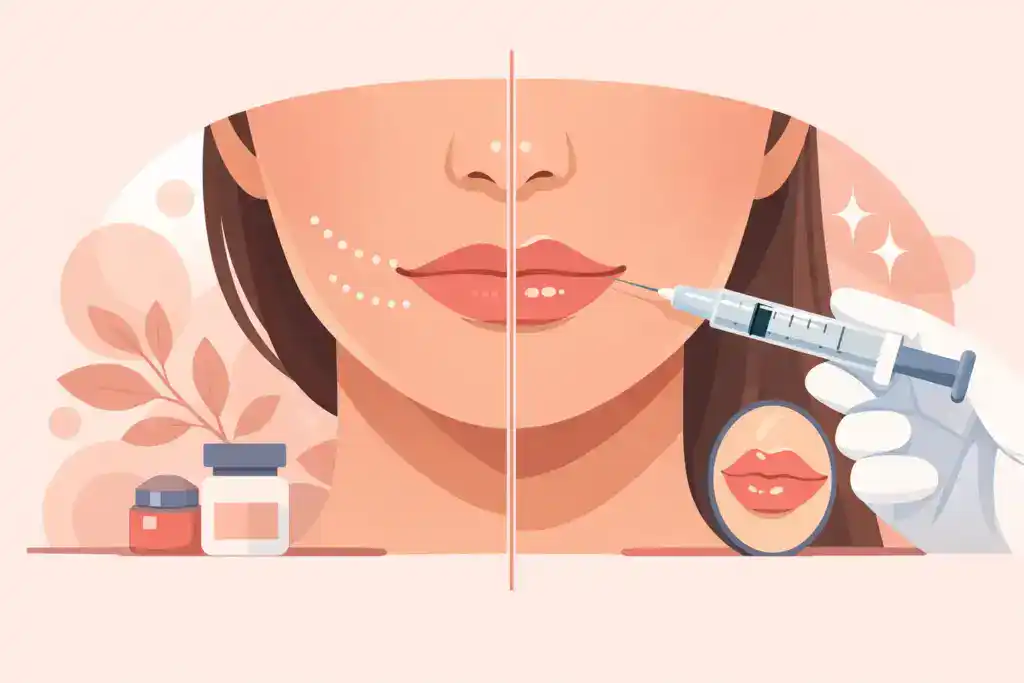
A good subtle lip filler before after is usually hard to spot at first glance. That is the point. The lips look smoother, better supported, and more proportionate to the rest of the face, but they do not announce that filler was done. For many patients, especially professionals and adults who want refinement without obvious change, that distinction matters more than volume alone.
The most convincing lip results rarely come from simply making the lips bigger. They come from respecting facial anatomy, correcting small asymmetries where appropriate, restoring structure that has softened with age, and preserving movement. In a physician-led setting, lip filler should be treated as a precise medical aesthetic procedure, not a trend treatment.
What subtle lip filler before after really means
When patients search for subtle lip filler before after photos, they are often looking for reassurance. They want proof that filler can look elegant, not exaggerated. They want to know whether their lips can look refreshed without changing their identity.
Subtle results are defined less by syringe count and more by proportion. A refined outcome may include a softly hydrated lip body, improved border definition, better upper-to-lower lip balance, or a more supported Cupid’s bow. In some patients, the most noticeable improvement is not size at all. It is reduced lipstick bleeding, less flattening with age, or a more rested appearance around the mouth.
This is where technique matters. The same amount of product can look natural in one set of lips and overdone in another, depending on anatomy, placement, tissue characteristics, and injector judgment. A conservative plan generally prioritizes structure and harmony before volume.
Why natural-looking lip filler is harder than it seems
Lips are highly expressive. They move when you talk, smile, eat, and rest. That makes them one of the most unforgiving areas to treat. A heavy hand can blur the vermilion border, distort lip shape, or create fullness that looks disconnected from the rest of the face.
Patients also arrive with different starting points. Some have naturally thin lips and want modest enhancement. Others have lost definition over time and need restoration rather than augmentation. Some are concerned about asymmetry, but true symmetry is rarely possible or even desirable. The goal is improvement, not geometric perfection.
There is also the question of facial context. A lip that looks balanced on one face may look too full on another. Subtle enhancement requires a deep understanding of surrounding anatomy, including the philtrum, chin projection, dental support, and perioral lines. In many cases, the best lip outcome is achieved by thinking beyond the lips alone.
What to look for in before and after photos
Not all before and after images are equally useful. Well-executed photos should show consistent lighting, angle, facial expression, and timing. If the after image is heavily posed, overlined, or taken immediately after treatment, it may not represent the final result.
Look closely at shape, not just size. A natural result tends to preserve the patient’s original lip character while improving definition and balance. The lips should still fit the face. The mouth should look relaxed, not strained. The upper lip should not appear projected far beyond the lower lip unless that was already part of the patient’s natural anatomy.
It is also worth noticing whether the result looks smooth in motion-sensitive zones. Overfilled lips can look puffy above the lip line or overly rounded in the center. Subtle filler should support the tissue without creating that inflated appearance.
Signs of a refined result
A polished after photo often shows cleaner lip borders, gentle hydration, and a soft increase in central fullness. Fine lines may appear less pronounced, and lipstick may sit better. The change is visible, but it does not overpower the lower face.
For mature patients, a strong result may be one that restores what has been lost rather than creating a youthful trend shape. That can mean delicate support along the border, correction of age-related deflation, or improving mouth corners as part of a broader treatment plan.
Signs a result may be too aggressive
If the lips look stiff, disproportionately forward, or uniformly swollen from corner to corner, the treatment may have been pushed too far. Another common issue is filler migration, where product sits above the natural border and creates a shelf-like effect. This is one reason conservative treatment and appropriate follow-up matter.
The consultation matters as much as the filler
Subtle lip work starts well before injection day. A thoughtful consultation should assess your goals, medical history, lip anatomy, previous filler history, and tolerance for downtime. It should also address what is realistically achievable in one appointment.
This part is especially important for patients who say, “I want natural results,” because natural means different things to different people. For one patient, it means a barely-there enhancement. For another, it means obvious improvement that still avoids a dramatic look. Clear communication helps align expectations with a treatment plan.
At Leo & Lucy Medical Aesthetics, a physician-led, evidence-based approach supports this process by prioritizing anatomy, safety, and individualized planning over one-size-fits-all volume. That tends to produce the kind of result patients appreciate months later, not just in the treatment chair.
How subtle lip filler is typically achieved
The best approach is often incremental. Instead of chasing a dramatic same-day change, many experienced injectors prefer to build shape gradually. That may mean using a conservative amount of filler, allowing the tissue to settle, and reassessing after healing.
Product selection also matters. Different hyaluronic acid fillers behave differently in the lips. Some are softer and better suited for hydration and gentle contour, while others provide more structure. The right choice depends on tissue quality, lip thickness, movement, and the specific aesthetic goal.
Injection technique further shapes the outcome. Small, strategic placements can improve contour and support while preserving softness. More product is not necessarily better. In fact, subtlety often depends on knowing where not to inject.
What to expect after treatment
Immediately after lip filler, the lips usually look larger than the final result. Swelling is normal, and minor bruising can occur. This is why immediate after photos should be interpreted cautiously. The true outcome becomes more reliable after the initial swelling settles.
Most patients can return to normal activities quickly, but there may be a few days where the lips feel firm or look uneven. That does not always mean the final result will be uneven. Early healing can be deceptive. Patients should follow aftercare instructions carefully and avoid judging the result too soon.
There is also a practical trade-off with subtle treatment. Because the enhancement is conservative, some patients feel they want more once the swelling resolves. Sometimes that is appropriate. Sometimes it reflects how quickly people adapt to change. A good injector helps patients decide whether additional filler would genuinely improve balance or simply move the result away from the original goal.
Who is a good candidate for a subtle approach
Many adults are better suited to subtle lip filler than they realize. Patients with early age-related volume loss, flattening of the upper lip, mild asymmetry, or vertical lip lines often benefit from refined correction. Younger patients who want polish rather than obvious fullness can also be excellent candidates.
The subtle approach is often ideal for first-time filler patients. It allows them to experience the treatment with less risk of overshooting their comfort level. It is also a strong fit for anyone in a client-facing role or professional environment where looking refreshed is welcome, but visible cosmetic work is not.
That said, subtle does not mean identical for everyone. A patient with naturally very thin lips may still see a meaningful change from a small amount of product. Another patient may need a staged plan to reach a balanced result because of baseline anatomy or prior filler.
Safety, longevity, and the value of restraint
Lip filler is common, but it is still a medical procedure. Expertise matters because the lips are vascular, mobile, and anatomically nuanced. Safe treatment requires careful product choice, sterile technique, knowledge of complications, and an injector who knows when to stop.
Longevity varies. Metabolism, product type, movement, and previous treatments all influence how long results last. Lips tend to break down filler faster than less mobile areas, which is why maintenance may be needed. But frequent topping off is not always the answer. Repeated overcorrection can compromise natural shape over time.
Restraint is often what keeps lips elegant. The most successful long-term results usually come from measured maintenance, regular reassessment, and a willingness to let the face guide the treatment rather than trends.
If you are considering lip filler, the most useful question may not be, “How much bigger can my lips get?” It may be, “What would make my lips look more balanced, healthy, and naturally mine?” That is where subtle work becomes its own form of artistry.