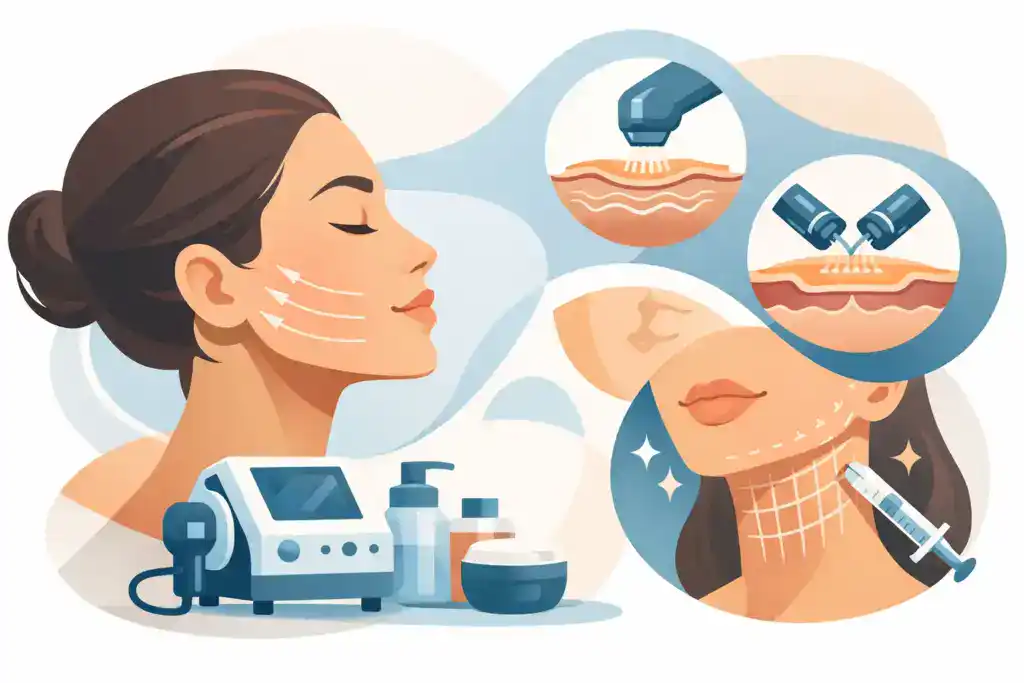
Skin starts to change in ways that are hard to ignore. Makeup settles differently. The jawline looks softer in certain lighting. The lower face, neck, or around the eyes may seem less firm, even when you are well rested. When patients ask about skin tightening treatment options, they are rarely asking for a dramatic change. More often, they want to look fresher, firmer, and more like themselves.
That distinction matters. Skin laxity is not a single issue, and there is no one-size-fits-all solution. The most effective approach depends on where the laxity is happening, how advanced it is, your skin quality, your age, and whether volume loss or muscle movement is also contributing to what you see in the mirror. A thoughtful treatment plan should reflect all of that.
What causes skin to loosen over time?
Skin firmness depends on collagen, elastin, hydration, and structural support beneath the surface. With age, collagen production slows and elastin fibers become less resilient. Sun exposure accelerates that process. Weight changes, genetics, and hormonal shifts can also affect how quickly skin begins to thin or sag.
In some patients, the first signs appear as crepey texture under the eyes or mild laxity along the jawline. In others, the concern is broader, with visible descent in the cheeks, neck, or lower face. It is also common for skin laxity to appear alongside volume loss, meaning the problem is not only loose skin but reduced support underneath it.
That is why treatment selection should never be based on a trend or a single device alone. Good outcomes come from understanding the anatomy first.
Skin tightening treatment options: what actually works?
There are several evidence-based skin tightening treatment options used in medical aesthetics. Each works differently, and each has a place when chosen carefully.
Radiofrequency treatments
Radiofrequency uses controlled heat to stimulate collagen remodeling in the deeper layers of the skin. Depending on the technology, it may be used on the face, neck, or body and may range from gentle maintenance treatments to more intensive procedures.
This category is often appealing for patients with mild to moderate laxity who want gradual improvement with limited downtime. Skin may feel firmer over time, and texture can improve as collagen rebuilds. Results are not immediate in the way a filler result can be. They develop progressively over several weeks to months.
The trade-off is that multiple sessions are often recommended, and outcomes depend heavily on the device, the treatment settings, and the expertise of the provider.
Ultrasound-based tightening
Focused ultrasound delivers energy deeper into the tissue to stimulate collagen at structural levels that are difficult to reach with more superficial treatments. It is often considered for lifting and tightening in areas such as the brow, lower face, jawline, and neck.
For the right candidate, ultrasound can create a subtle lifting effect and improved firmness over time. It tends to suit patients with early to moderate laxity who are not ready for surgery and who understand that the result is refinement, not replacement for a surgical lift.
This distinction is important. Ultrasound can be valuable, but expectations must be realistic. Patients with significant skin redundancy or heavier tissue may need a different plan.
Microneedling with radiofrequency
This approach combines controlled micro-injury with heat delivered beneath the skin. It is particularly useful when laxity is paired with textural concerns such as enlarged pores, acne scarring, or crepey skin.
Because it addresses both collagen stimulation and skin quality, it can be an excellent option for patients who want firmer skin with a smoother surface. It is commonly used on the face, jawline, neck, and sometimes the body.
Recovery varies by intensity, but redness and swelling are expected in the short term. Like other collagen-based treatments, results build gradually.
Laser resurfacing and collagen remodeling
Some laser treatments improve firmness indirectly by stimulating collagen while also addressing pigmentation, fine lines, and texture. This can be particularly helpful when skin aging is not only about looseness but also sun damage and uneven tone.
The advantage here is that one treatment plan can address several concerns at once. The limitation is that not every laser is designed primarily for lifting, and not every skin type is suited to every laser platform. Device selection, settings, and pre-treatment planning are essential for both safety and outcome.
Injectable support for the appearance of firmness
Not every patient with “loose skin” needs a tightening device first. Sometimes the face looks less firm because foundational volume has diminished. Strategic dermal filler can restore support in areas like the cheeks, temples, or jawline, which may improve the overall appearance of laxity.
There are also biostimulatory injectables that work by encouraging collagen production over time. These can be useful in selected patients who want gradual, natural-looking improvement rather than immediate volume alone.
This is where physician-led assessment matters. Overtreating with filler in an attempt to compensate for true skin laxity can create an unnatural result. Used well, injectables can complement tightening treatments. Used poorly, they can blur the facial architecture.
Surgical referral when non-surgical care is not enough
A careful aesthetic practice should be honest about limits. If skin laxity is advanced, non-surgical options may offer some improvement but not the degree of lifting a patient is hoping for. In those cases, a surgical referral may be the most appropriate path.
That does not make non-surgical care ineffective. It means the treatment plan should match the anatomy and the goal.
How to choose between skin tightening treatment options
The best treatment is rarely the newest one or the most aggressive one. It is the one that fits your tissue, timeline, tolerance for downtime, and long-term goals.
Age alone is not the deciding factor. A healthy patient in their 50s with mild laxity and excellent skin quality may respond beautifully to collagen-stimulating treatments. A younger patient with sun damage and post-weight-loss skin changes may need a more layered approach. Someone with noticeable jowling and heavier lower-face descent may benefit from combining modalities or considering surgery if they want a more significant lift.
A good consultation should assess more than the surface. It should look at skin thickness, elasticity, facial volume distribution, muscle activity, and overall balance. In a physician-led setting, that evaluation helps prevent the common mistake of treating one visible symptom while missing the larger structural issue.
Why combination treatment often gives the best result
Skin aging is multidimensional. Laxity, volume loss, texture change, pigmentation, and dynamic movement often develop together. Treating only one of these may help, but the result can feel incomplete.
For example, a patient might improve jawline firmness with ultrasound or radiofrequency but still feel tired-looking because of midface volume loss. Another patient may tighten the skin successfully but remain bothered by etched lines caused by repetitive movement. In these cases, a combination plan may include energy-based treatment, injectables, and medical-grade skin care spaced over time.
This layered approach tends to produce the most natural outcome because it respects how the face actually ages. It is less about chasing a single dramatic intervention and more about restoring balance.
What kind of results should you expect?
The most satisfying results are usually subtle enough that other people notice you look well, not treated. That is especially true with skin tightening, where collagen remodeling takes time and the effect tends to appear gradually.
Most non-surgical treatments improve firmness and skin quality rather than creating a major lift. You may see better definition, smoother texture, and a more rested appearance. You should not expect the result of surgery from a non-surgical treatment.
Maintenance matters as well. Collagen stimulation can be meaningful, but the aging process continues. Thoughtful follow-up, sun protection, and skin health support help preserve results.
The value of physician-led planning
When treatment involves heat, tissue depth, facial support, and long-term aesthetic balance, medical oversight is not a luxury. It is part of responsible care. A physician-led clinic brings a deeper understanding of anatomy, device selection, safety, and how different modalities interact over time.
That matters not only for outcomes, but for restraint. In aesthetics, the best work is often the least obvious. At Leo & Lucy Medical Aesthetics, that philosophy aligns with a more refined standard of care: evidence-based planning, personalized treatment selection, and results that support natural beauty rather than overpower it.
If you are considering skin tightening, the goal should not be to chase every option available. It should be to choose the right option, at the right time, for your face or body, with a plan that still makes sense a year from now.